 by
by Thoughts On Art and Creativity.
While many of us are aware that we need to learn and practice painting techniques in order to improve, the emphasis can sometimes be on seeking shortcuts, tips to allow us to master individual techniques, and secret tricks. I think we often forget about the other skills necessary to be creative and make good art. Many of those skills I also find relevant to living a good and meaningful life; the things I learn from art tend to be helpful when translated to my life. I will share below what I think are a few of those things I want to work on. I like to think of it as looking at the big picture.
I wanted to write something in a different way this time. I’m thinking of this as a slim black notebook to corral and contain some distilled art knowledge that I want to remember as I go along, almost like a journal to myself. It may contain insights and philosophies about creativity, methods of working, themes important to me, and perhaps techniques and thoughts on color, whatever seems pertinent and helpful to what I am curious about and learning. It won’t necessarily even be constructed all in complete sentences. And it will be an incomplete, ongoing project (undoubtedly with other segments and revisions at a later date). These are not rules. Take and use what you find useful.
ART REQUIRES…
An artist needs three things (according to Maya Angelou):
- Knowledge of basic techniques and skills. (Artists will always need to continue to practice and improve their skills.).
2. Something you want to say/express. Everyone wants to be heard.
(Know yourself – what matters to you.)
3. Courage to SAY what you believe!
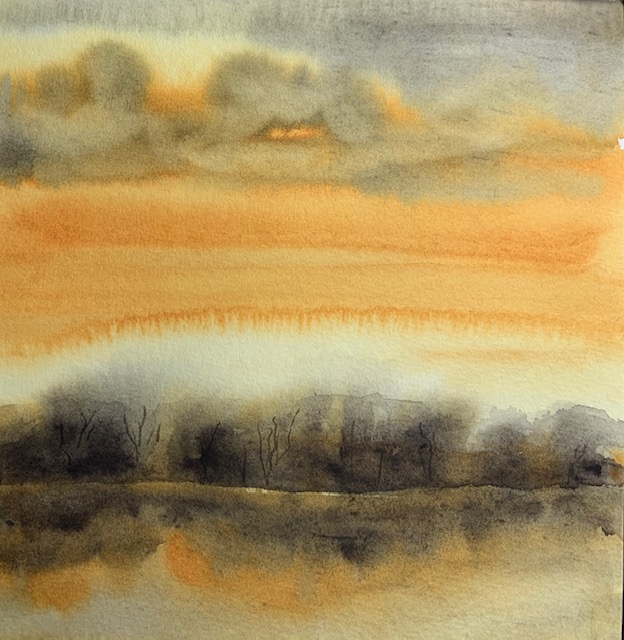
Experimental Watercolor Landscape.
FLAT OR FULL OF LIFE.
Painting is a release of ENERGY. When you make a painting and its outcome (result) all-important, it changes the energy of your painting. It can take the life (and mystery and power and energy) right out of the art. This is why copies and overworked art can look flat, lifeless.
An artist seeks glimpses of an inner landscape, one beyond our understanding. Art is a PORTAL to the unseen world. Unconscious. Inner knowing.
‘Thinking’ won’t get you there. DON’T try or force or control or be perfect – it gets in the way. It’s a fallacy that holding tight and controlling creates success; instead, it kills spontaneity and discovery. It makes life a drudgery, not playful or enjoyable. Forcing a result makes it difficult to relax or notice your inner intuition and inspiration. Let go of the outcome.
CONTROL VS. ALLOWING.
Your ‘Thinking’ mind wants to know what’s next. But the ‘Creative, artist’ mind prefers not to know and recognizes we CAN’T actually know what’s next. We can only take the next step, see what happens, react, continue effortlessly and easily. FLOW. Don’t kill spontaneity and surprise and magic by trying to impose a certain result.
Don’t think while painting – hold off on reflection and critique until your painting session stops, to avoid fussy and tight results. By not being focused on the thoughts in your head while painting, you allow feeling, instinct, and energy to exist in your painting.
ALLOW. Don’t be tempted to talk or think about not making fast enough progress. A quest for efficiency discourages looking carefully or deeply. Feeling you have to rush to get it done, arrive at a destination, make a ‘finished’ painting, have a breakthrough, improve your art means you’re NOT paying attention to what you ARE learning/feeling or where you are now in the process. You are AVOIDING looking too deeply. You won’t get ’there’ if you’re impatient, have expectations. There are no shortcuts or tricks. The best artists are NOT the ones who rush to the end – they’re the ones who ENJOY the process enough to stay in it, allowing things to grow at their own pace.
Be here now, in the present. Stay focused on how you are feeling when creating, rather than worry about what lies ahead. Art isn’t about finishing; it’s about growing.
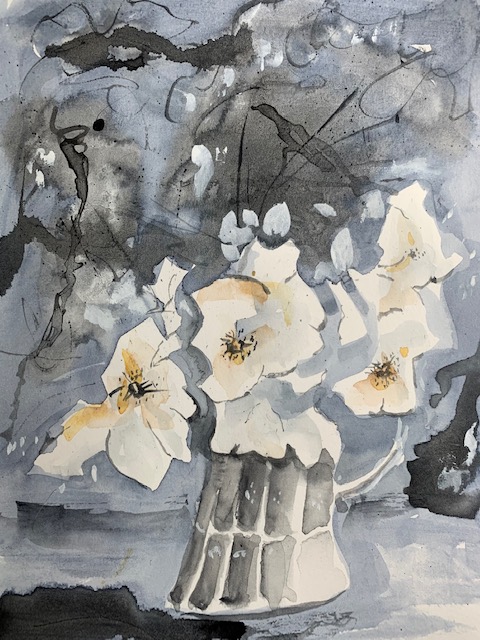
Experimental Ink and Watercolor.
When we rush, we rob ourselves of discovery. We don’t allow our ideas to evolve, take unexpected turns, deepen over time. We don’t nurture those tiny, quiet sparks that could grow into something truly exciting. If we never give ourselves permission to EXPLORE, how can we ever stumble upon something new?… Slow down and let your art breathe. (Louise Fletcher)
(Impatience is having an argument with reality. It is the feeling/desire for something to be different than what it IS.) Patience is developed much like awareness – through an acceptance of what is.
When it comes to the creative process, patience is ACCEPTING that the majority of the work we do is out of our control. We can’t force greatness to happen. What we can do is invite it in and await it actively, not anxiously. (Rick Rubin, Annie Dillard) Get a little lost on the way – explore (Rebecca Solnit, Louise Fletcher, Sue Monk Kidd). Moodle (Brenda Ueland). Notice what rises naturally to the surface of your awareness.
PROCESS.
Process: Play. Experiment. Ask questions. Follow your curiosity. Set your own assignments (depending on your interests snd preferences). Notice connections to see a way forward. (You won’t necessarily know the way forward.) Make.
PLAY. Do whatever you want. Just respond to the next thought that comes into your head. Play without pressure. Try something with no expectation of a final result, just to see what happens. Follow the fun. (When your painting is a struggle, go back to play mode.)
ASK QUESTIONS of yourself and your work. Don’t rush to answer them. You needn’t settle for your first idea, which is rarely your best. Give yourself freedom (and permission) to explore fully, to experiment, to get a little lost along the way.
HOW to approach a question? A question involves wondering, searching for a way. A question is a starting point. One of the most helpful questions to ask is “What if…(you create a hypothesis, a guess that you want to investigate, and test.)? You must seek though you cannot know what it is you’re looking for (until you find it). The question can function as a guide to help you uncover connections. “How can I …?” is another question to help find clarity.
EXPERIMENT. One thing follows another. Successful outcomes often follow unpredicted actions. If we allow ourselves to do things that might not work, we’re far more likely to discover the things that do. (Seth Godin) Experiment to discover.

Experimental Watercolor Landscape.
Take action. Make, make, make. Try things. “Try it and see.” (Megan Auman) You generate ideas by doing. Your feet create your path by exploration. Improve your work by actually painting regularly and often.
DON”T SILENCE YOURSELF.
Don’t ask what the world needs. Ask what makes you come alive, and go do it. Because what the world needs is people who have come alive. ~ Howard Thurman, author, educator (1899-1981)
You need to know yourself – what matters to you, what you care about – to practice choosing and deciding for yourself, noticing the spark of your own inspiration, not hiding or silencing yourself.
What you find EASY and FUN is your gift! It is what you NEED to do – DON’T feel guilty – it’s not supposed to be hard work, unpleasant!!! Your job is to be TRUE to yourself!
What excites you = your FOCUS. It resonates, fizzes, sparks. You must follow all nudges. Don’t say “no” to yourself, your ideas. Each time you say no to yourself, you build more of the wall that imprisons you and kills your dreams.
Don’t infantilize yourself or be convinced you should make yourself powerless. (Seth Godin) Stop repeating and rehearsing negative self-talk. Don’t avoid new ideas. Do avoid useless feedback. Don’t wait to get picked. Don’t undermine your own work. No blaming. Don’t be afraid, or if you are afraid, then do the thing anyway. Waiting for permission keeps you small.
Don’t avoid your own creativity behind the excuse of taking care of others, or even spending all your time encouraging others to be themselves and express their creativity. Don’t neglect your own nurturance and creativity – fit it in – it’s NOT selfish! Accept, trust, respect your own needs and desires. NEVER APOLOGIZE anymore about your work, where you are, or how you feel. Honor it. Do you! (Danny Gregory) What you have to say is important – literally your VOICE. Don’t hide. Speak up.
Cultivate courage/ self-trust/ self-belief to be able to speak up. (e.g. confidence, making up your own mind, not needing others for validation and direction, not trying to impress.) SAY what you believe! Create an environment where you are free to express what you are afraid to express.
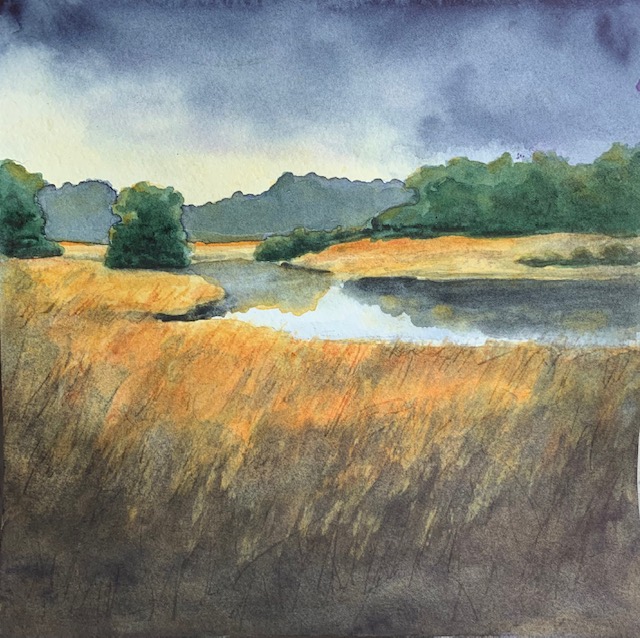
“Golden Field” Watercolor Painting.
TO SUMMARIZE … SO FAR.
This is a good place to stop writing, for now. I have included some distilled art knowledge that I find interesting and want to remember as I go along in my painting, information that has meaning for me. It functions almost like a journal to myself containing whatever seems pertinent and helpful to what I am curious about and learning. I see it as an incomplete, ongoing project (undoubtedly with other segments and revisions to follow at a later date). These are not rules. Take and use what you find useful.
Selected Resources:
Sue Monk Kidd: Idea of ‘the slim black notebook’ of your own repertoire of techniques and philosophy. (P. 114, Writing Creativity and Soul.)
Maya Angelou: “There are only three things you need in order to write. First, you need something to say. Second, you need the ability to say it. Finally, you need the courage to say it all.”
Join me and get painting tips, inspiration, recent art news, or information about new art or products for sale, sent to you by email. Subscribe here. I’ll give you a free copy of my Color Blending Tips pdf. that you can download and print.
 Lee Muir-Haman Watercolor Painting
Leave a comment