 by
by Many painting students want to ‘loosen up’ their art. They have heard that painting more loosely is a good thing. What do they really mean? Do they really want to loosen up? How does someone paint loosely? I believe when we hope for looseness, we want our art to appear dynamic, confident, fresh, and relaxed, rather than overworked.
However, as we are learning to paint, we often strive instead for an exact likeness of what we are painting. We mistakenly believe that should be our big goal. However, desiring a perfect likeness may cause us to overthink and overcomplicate what we are doing, trying to get our picture “just right.” We can become focused on painting all the precise details, on correcting and reworking every tiny mistake. As a result, we hold our brushes (often too small brushes) tightly and increase our tension and anxiety about results. Often, everything in the painting ends up with hard, sharp edges. Stiff, overly controlled work can be the result.

‘Apples’ Watercolor Painting.
Unfortunately, creating an exact likeness of your reference may NOT be the most appropriate goal for successful painting. While some award-winning painters do produce super-realistic art, they usually put their own spin on it by offering an unusual (and personal) point of view in their images. These artists generally are rearranging and creating their own compositions. They are not copying a scene precisely as found.
If someone tells you that your painting looks like a photograph, don’t automatically take that statement as a compliment. The implication is that you have actually copied the photograph or reference rather than using it for inspiration, information, or presentation of your own unique viewpoint.
CHOOSE. SUPER REALISTIC IS NOT LOOSE.
It seems to me that an artist cannot paint an exact likeness while also trying to paint more loosely. Aren’t these two different ways to paint? Perhaps we should reconsider our beliefs about what makes a successful painting. Is our goal precise copying (like botanical painting) or more personal, dynamic work (like the famous artists Sargent or Sorolla)? There is room for all types of interpretations — no choice is wrong — yet each painter must consciously choose what THEY are hoping to achieve.
ADJUST BOTH MINDSET AND TECHNIQUE, IF DESIRED.
If you wish, you can learn and practice looser painting. You will undoubtedly give your painting more life and personality. An attitude change may be necessary, however, to relax any overly high expectations for your work. Hoping for perfection makes loose, relaxed painting highly unlikely. While technique and design elements do need to be mastered, an artist’s mindset (expectation and attitude) has a huge effect on every aspect of painting! Whatever emotions an artist is experiencing can often be observed in their painting. Uncertainty and fear can come across through tentative, uncertain brush strokes or pale, washed out colors. A creator in a rush can be sloppy and less than observant. A tense artist trying to control their pigment and avoid mistakes will paint a stiff, tight picture. In contrast, a more relaxed and confident painter automatically creates with a bolder, looser stroke. In many ways, painting echoes and reflects each artist’s attitudes and emotions, so don’t try to be perfect or create a painting masterpiece. Understand that everyone makes mistakes, which are useful learning tools and therefore nothing to fear. If you struggle with anxiety about mistakes, take a look at ‘Prevent, Correct, And Reframe Your Painting Mistakes’, (11/14/2022), https://leemuirhaman.com/2022/11/14/prevent-correct-and-reframe-your-painting-mistakes/ .
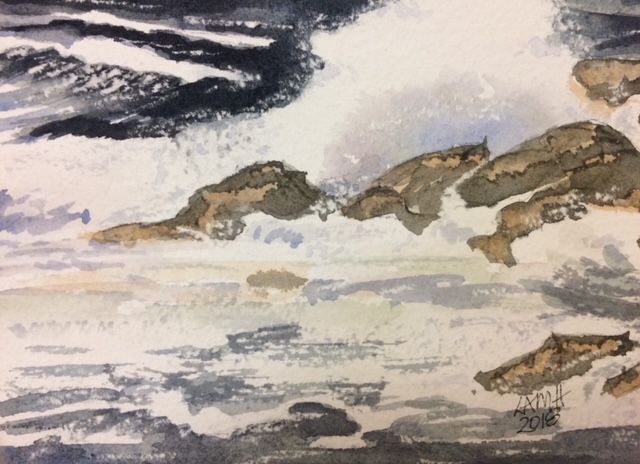
‘Rocks and Waves’ Watercolor Painting.
To paint more loosely and expressively, try to:
- Paint with quick and lively, confident brush strokes.
- Use larger brushes, allowing you to make fewer, bolder brush strokes with less emphasis on tiny details.
- Do not attempt to include every detail from a photo or reference in your painting. Eliminate busyness.
- Simplify and focus on your interpretation of the center of interest.
- Try to focus on more simplified shapes to avoid getting distracted by unimportant details.
- Paint hard, soft, and lost edges, i.e. varied edges, to help the viewer get interested and involved while looking at your image.
- Focus on the process of painting rather than worrying about results – Never mind what you end up with!
- Outdoor painting (en plein air) is an excellent way to start painting more loosely because you have limited time to paint and don’t use others’ photo references. You decide your own subject and focus during your painting session. Include or leave out whatever you wish. Since you are determining your main concept, edit out anything that is not important to the story you will be telling in the painting.
- Directional strokes, such as those used to create a swirling cloud or flowing water, help you describe movement and the essence of a scene without painting every detail. They can help direct the viewer’s eye toward the focal point. (Interestingly enough, directional strokes themselves can actually follow a direction and pattern that simulates what you’re painting. They can swirl like clouds, blow like hair in the wind, or flow and ripple like water – a visual form of onomatopoeia.)
- Further, you may be interested in exaggerating certain elements in your painting, such as pushing colors or values beyond what you actually see, to emphasize your interpretation of your subject.
- Finally, know when to stop! Avoid trying to correct every little mistake. Don’t overwork your painting. Instead, stop painting just BEFORE you feel you might be finished.
- Before getting into serious painting, do some warm-up exercises, as you might before a long race or basketball game. Play with marks and colors in your sketchbook or on scrap paper. Continue to play around until your mood is easy and relaxed. You’ll be less tense and worried when you shift your attention to actually painting your image.
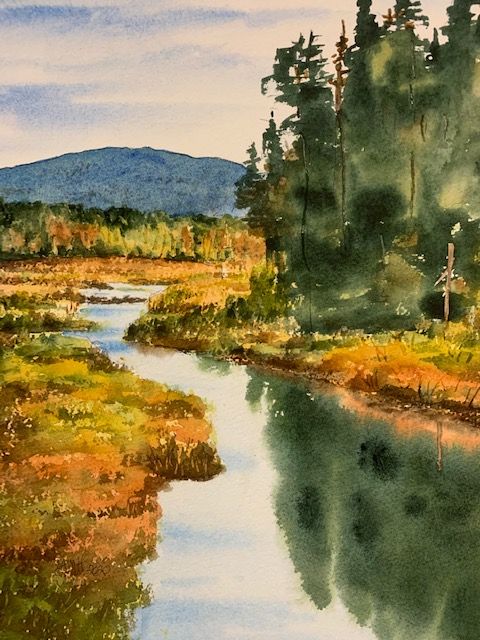
‘Swamp’ Watercolor Painting.
Painting loosely may require a shift in both process and thinking. Once you’ve felt this more relaxed attitude and tried the above suggestions, you’ll know how to recreate the mindset yourself and begin to paint more loosely whenever you want to.
Join me and get painting tips, inspiration, recent art news, or information about new art or products for sale, sent to you by email. Subscribe here. I’ll give you a free copy of my Color Blending Tips pdf. that you can download and print.
 Lee Muir-Haman Watercolor Painting
Leave a comment