 by
by I wonder if we rely too much on other people to tell us if our watercolor painting has value, is well done, or what we could do more or less of to improve it. Can we really rely on the opinions of friends, relatives, and acquaintances to give an unbiased or constructive evaluation of our work? I know it depends on the person, but who is the right person? Most feedback I hear is polite and sounds like “Oh, I like that!” or “That looks great!”. Compliments are fun, but… sometimes I’m still left wondering.
While it’s nice to be able to hear unconditional approval from friends and fellow painters, I think I learn more from an honest and balanced (but supportive, of course) appraisal of the work. In order to improve, I will benefit from considering BOTH strengths (what I need to repeat and do more of) AND weaknesses (what I could improve). To focus ONLY on weaknesses (or only strengths) is self-defeating.
“Critique” is often a scary word, making us think of criticism, belittling, and nit-picking. The word suggests that someone will find fault with or judge our work with hurtful severity. I don’t suggest this kind of humiliation at all. That’s why I prefer words like “evaluation” or “analysis.” Overt criticism is extremely discouraging.
BALANCED FEEDBACK FROM OTHERS AND YOURSELF.
Instead, I am encouraging an objective and balanced examination of each painting you work on – both support and helpful suggestions for improving. Many fellow painters (though not all) can provide encouraging and helpful ideas, especially if you make it clear that you are open to problem-solving and working out constructive, specific ideas to try next time. Most watercolorists share your struggles and hopes in learning watercolor painting. They know how you feel.
It’s also important to know how to evaluate your watercolor paintings for yourself, however. If you are unable to find a kind, knowledgeable fellow painter (or teacher), then knowing how to examine your own work is invaluable. You can then make an unbiased, objective review at any time.

‘Diving Boys’ Watercolor Painting.
BE OBJECTIVE.
The most difficult part of analyzing your own paintings is being impartial. We are often emotionally invested in our work and thus can have trouble seeing it objectively. Emotions can skew how clearly you see your painting – this is natural. To become more detached and objective, step away from your picture for a time. You could set the painting aside for a day or two. Try not to evaluate art as soon as you finish painting.
Another way to increase your detachment from a painting is to take a snapshot of it with your smartphone. For some reason, seeing a photo image can provide just enough distance from your work to make it feel less personal. Then you can analyze your photo more objectively.
UNBIASED MINDSET.
As you evaluate, control any tendency to focus first on all your mistakes. Small mistakes don’t matter, so don’t be overly distracted by them. It is important to set aside criticism of the little things as well as negative judgements of your abilities. You will be unable to provide yourself with a balanced, accurate, unbiased, or helpful assessment if you focus only on problems. Remember, every painting has STRENGTHS and WEAKNESSES, and you should consider both in your evaluation. What worked and was painted well that you should continue and build on? What could have been improved, and how exactly could you improve it next time? Your aim is to PROBLEM-SOLVE.
THE WHOLE. A CLEAR MESSAGE.
Consider the painting as a whole. Set the painting up and look at it from across the room. What impression does the painting make? Does it get across the message you were hoping to send when you decided to paint it? Does the painting accomplish your objectives? In other words, WHY did you paint this image? Because you loved the light falling on the hills, or because the scene seemed relaxing, or because it was filled with laughing people having fun and made you feel happy? Have you captured that impression?
Take the time to think about and experience what the image means to you. Your job as a painter is not to copy and paint exactly what you see, but to paint your impression of the parts most important to you. Don’t skip this introspection! How will you know if you have accomplished your intentions if you don’t consider your aims? What has attracted YOU to this image? The reason you painted this picture is your personal connection, and that connection should come across in the finished painting. Is your message clear? All good paintings have a simple, clear idea. You should be able to say what this idea is, in a few sentences, if someone asks.
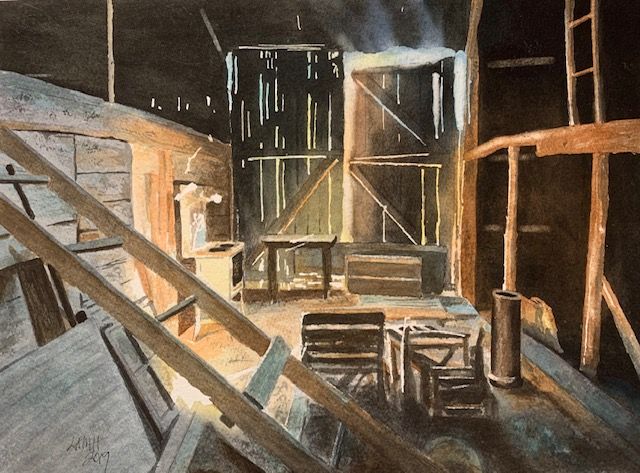
‘Tristan’s Barn’ Watercolor Painting.
CENTER OF INTEREST.
Having set your painting up, notice what you look at. Which part of the picture is your eye attracted to first? Ideally, your eye is drawn to your chosen center of interest. The eye will generally notice first the spot with the most contrast. You want to draw attention to the center of interest so that the viewer focuses here. It’s WHAT your painting is about. (Make sure to choose only ONE focus. You must choose.)
If your eye is drawn elsewhere first, you might want to increase contrast (whether contrast of value, color, shape, or edge) at your center of interest to emphasize this part of your picture. Remember that a full range of light and dark values, from darkest darks to lightest lights, can create more impact. You could also add a pop of complementary color at your focal point to attract attention.
VARIED DETAILS.
Further, a center of interest tends to be the most detailed area of the picture, since detail also attracts the eye and tells your viewers where you want them to look. Ideally, keep other sections of a painting LESS detailed and thus less emphasized. All parts of your picture are NOT equally important and, therefore, should not be equally detailed. How did you deal with detail in your painting?
VARIED EDGES.
Since the viewer’s eye is drawn to hard edges, it makes sense to create hard edges at your focal point. But edges can provide a lot of other information about your scene. They can tell the viewer how strong your light source is. Varying edges can create depth and suggest distance, indicate how far away objects are, whether they are in the foreground or background. With edges you can show how clear, cloudy, or foggy and hazy the weather is. (Bright, sunny days create harder edges than cloudy or rainy days.) And edges will also convey how important each part of the composition is – less important sections of a painting need to have softer or lost edges so as not to attract a lot of attention. Did you paint hard, soft, AND lost edges where they needed to be?
Controlling wetness helps to create the desired edge quality in watercolor. How did you do judging the wetness of the paper compared to the wetness of the paint and brush? Do you need to practice judging wetness to improve your ability to create the edges you want to create? If so, get some scrap paper and practice painting hard edges, soft, and then lost-and-found edges, while varying the dampness of the scrap paper. You might also rehearse ‘softening’ an edge (an essential watercolor skill) on scrap paper.

‘Eerie Light’ Watercolor Painting.
DID YOU CREATE A PLAN OF ATTACK BEFORE PAINTING?
Did you plan your approach to this painting before picking up your brush? Did you think about rearranging the major shapes in a balanced, pleasing way to improve the composition? Did you test out your ideas first in a small value study? Did you crop, simplify, and leave out confusing details? Did you establish and save the lightest light values right away? Did you consider what colors would support the mood of the scene? If you didn’t do these things BEFORE painting, you may notice several kinds of problems in your work: perhaps a jumble of shapes but no focus, or values too similar to each other so nothing stands out, or even colors that don’t suit your subject or clash with each other, or maybe a background or sky tacked onto your painting as an afterthought, etc. Might thinking about the above questions early have helped improve the final painting?
TECHNIQUE AND ATTITUDE.
How was your technique in this painting? What was easiest for you, and what did you do well? Did you have difficulty figuring out the sequence of layering colors — what color can be laid down first, then what other colors should follow — or did you mistakenly try to paint everything at once? Were you scared you would make a mistake so your brushstrokes became small and tentative? Were you hesitant in your color mixes, ending up with timid colors? Next time, you could take a chance and try to be bolder.
If you noticed self-criticism and discouragement while painting, be patient and kind to yourself. It will help you relax. Try to be aware of how you’re feeling as you paint, since your emotions affect your brushstrokes and the quality of your work. When you’re tense, you might need to take a break and some deep breaths, calm down a bit, then return to painting with a more composed attitude. Remember that stepping away from a painting for a time can calm you and increase your objectivity.
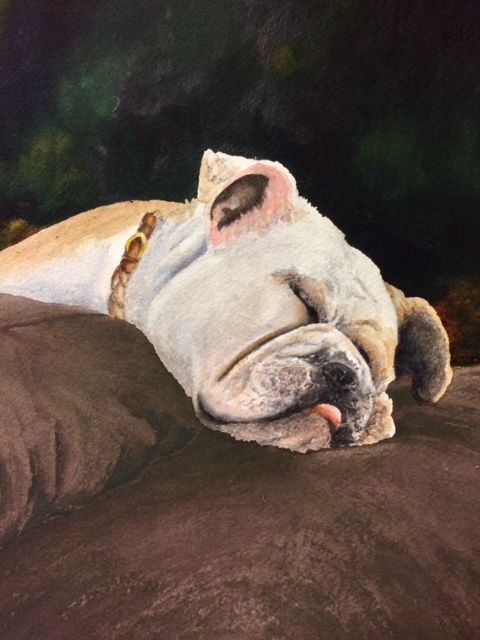
‘Just Relax’ Watercolor Painting.
ASK YOURSELF QUESTIONS WITHOUT NEGATIVITY.
Asking questions of yourself (without critical judgement) gets you in the habit of making deliberate decisions regarding your painting. This may not be easy in the beginning, but with practice it becomes easier, and you become better at it. These questions help you evaluate your work without bias, while considering value, wetness, color, composition, mindset, and technique. You can walk yourself through these questions for each painting. And start to decide what you like, what interests you, what you paint well, what areas you might want to improve. The more you examine objectively both your strengths AND weaknesses, the more confident you will become. As you work toward a balanced evaluation and rely on your own awareness, you take charge of your painting, while also increasing your painting skills and your decision-making ability.
Join me and get painting tips, inspiration, recent art news, or information about new art or products for sale, sent to you by email. Subscribe here. I’ll give you a free copy of my Color Blending Tips pdf. that you can download and print.
 Lee Muir-Haman Watercolor Painting
This article is extremely helpful. I will save it to read again to remind myself of what to look for.
LikeLike
Glad you liked it!
For me, it’s almost like having a checklist of questions to ask myself to help me consider what I know I want to evaluate in my painting.
LikeLike