 by
by Let’s create a relaxing yet invigorating retreat to get our painting headed in the right direction for the year ahead.
After the busy holiday season you may be feeling tired, uninspired about getting back to your art, but wishing you could explore some new ideas, and hoping to get unstuck. A retreat is an ideal opportunity to step out of your daily routine to think about needed adjustments to your plans or goals. It’s a good way to take stock and gauge your progress in achieving your dreams. It can be a chance to unwind, renew, and restore your enthusiasm.
While it’s wonderful to sign up for an actual get-away retreat at a beautiful, exotic destination, that approach is expensive and requires travel. Many of us don’t have the money or the opportunity to leave our everyday life behind for any length of time. Instead, however, we could create a personal retreat for ourselves by setting aside time for rest, contemplation, and learning about and experimenting with art.
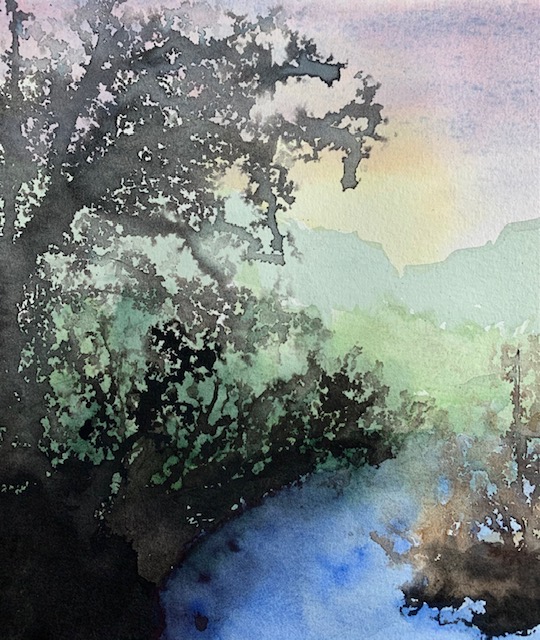
Watercolor/Ink Landscape Experiment.
Possible benefits of a personal retreat might include:
- Inspiration: An art retreat can provide both ideas and the energy to implement them.
- Skill development: An art retreat allows learning new techniques and improving already-acquired skills.
- Fresh perspective: An art retreat can provide a chance to explore new ideas and directions and to look at your creative process with fresh eyes.
- Creativity: An art retreat allows time to play, experiment, and become more creative and daring, as well as to reconnect to your desires, wants, and needs.
- Unwinding: An art retreat can help you release your stress, rest, and renew.
Your personal retreat can be about exploring and getting to know yourself – your likes/dislikes, your inspiration, your hopes and dreams about your art, learning what you’re drawn to and what excites you, what techniques you’d like to learn more about, what your next work might look like, exploring new ideas while being more conscious of what makes you want to paint in the first place.
STATE YOUR COMMITMENT.
Keep in mind, the hardest part of an art retreat or a mini retreat at home is giving yourself the permission to make it happen; to take the time to slow down, to rest, to forget about other obligations for a time. If you do, you’ll find out things about yourself and improve in your art skills in many ways. Committing to taking time for the retreat is important! We often have good intentions, but many things are competing for our time. Slowing down to devote time to do uninterrupted art can sometimes be a challenge, so promise yourself a specific amount of time and embrace your personal retreat fully. Strive for time for reflection, study, playing and experimenting with paint, resting, and getting inspired – whatever you feel you need.

‘Purple Swamp’ Watercolor Image.
JOURNAL.
Throughout this retreat, I suggest keeping a journal of your decisions and your experiences. It doesn’t have to be fancy; you could just use a small notebook or sketchbook for the purpose. Your reactions to this retreat process and what you’re learning will be a resource for the future. You can simply read your comments and list of observations and goals whenever you feel tired or uninspired. Reminding yourself of these thoughts will likely help you maintain motivation and focus.
DEFINE YOUR SCHEDULE.
You have the opportunity to design your retreat to meet your own needs. Commit to a specific time limit – I chose the month of January for concentrating on my retreat. I wasn’t able to spend every day, all day on it, but I committed to 3-5 mornings a week, depending on my schedule. (You could choose a different time commitment, perhaps an hour every evening or early morning, or every Saturday, for instance, during the month of February or for 6 weeks.)
PURPOSE.
Get specific about what you want to accomplish so it will be easier to organize your time. Record this in your journal to remind you later if you start to lose focus.
My purpose was/is to a.) rest and slow down, b.) take stock of my 2024 art practice, c.) go deeper and think about my dreams and art possibilities for 2025, d.) experiment and learn new art skills and techniques; try new things, play without judgment, e.) generate ideas about the direction I want my art to go, and f.) plan specific steps (short term and long term) I can take to move toward my goals. For this retreat time I do not intend to complete any finished paintings. I will simply rest, rethink, get inspired (I hope), and plan for the coming year.

‘House On A Hill’ Watercolor Experiment.
You may want to focus on something else. You may be eager just to slow down, get rejuvenated. Perhaps you are interested in getting unstuck and finding new inspiration. Choose the focus that excites you, and record it in your journal. This intention will determine how you spend your retreat time.
TAKE STOCK. CONTEMPLATE.
If part of your retreat will include taking stock of your art from the past year, collect and spread out your work from that time. Gather some information from your paintings. Look for clues about what appeals to you (without criticizing the quality of the work). What subjects do you come back to repeatedly? What do you want to say in your art? What themes keep cropping up? What did you accomplish during the year? What did you enjoy, or not enjoy? Did you paint as much as you’d hoped? What inspires you? What do you want to stop doing? Jot your thoughts in your journal – to look back on later.
I don’t want to spend my entire retreat time thinking about the past year, but a look back helps me to assess and recognize where I might like to go in the future and what my hopes are. I keep in mind what is important to me as I examine and contemplate past work.
In my taking stock, I found this year I was distracted with chores related to building a new house and I didn’t paint as much as I wanted. I also didn’t spend enough time writing for my art blog. I was, however, pleased that I painted almost daily, put time and effort into loosening up and painting with more feeling. I experimented with less controlled semi-abstracts and abstracts. I tried using some new materials, especially ink and water-soluble pencils and crayons. I found I disliked collage. Overall, I experimented a lot.
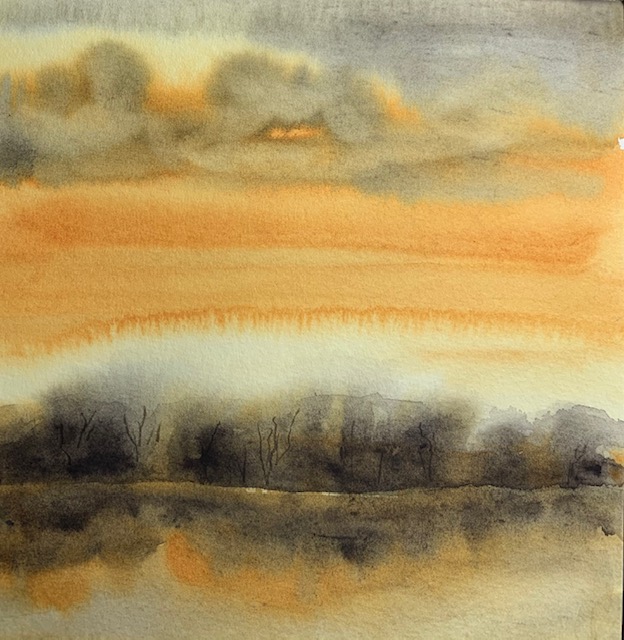
‘Clouds At Sunset’ Watercolor Experiment.
GET IDEAS FLOWING. GENERATE IDEAS.
Looking at your own work can sometimes give you a nudge toward a direction for your upcoming art. You can also look for inspiration and ideas in the work of other artists that you like and admire. Try to take a trip to the library, art galleries, museums, or art fairs to motivate you.
What hopes and questions does your exploration bring up for you? For example, I find Joaquin Sorolla’s paintings with their beautiful capturing of light exciting. I will try to study his work in an effort to decipher how he accomplishes it. And I also really admire John Singer Sargent: his vibrant colors, spontaneity, ability to see deep into his subject. I wonder how did he use composition, brushstrokes, and color to create such moving art?
TRY SOMETHING NEW. EXPERIMENT. IDENTIFY YOUR PATH.
By identifying several things that inspire me or excite me, I begin to have ideas about what I am curious about and what I might want to explore further. My subject matter tends to revolve around the natural world: often the New England trees, hills, water, farms. How can I incorporate the simplification and focus of Sargent using watercolor and brushstrokes? I could experiment with the possibilities of this question in a series of small paintings to see what I could do. Could I also combine these exercises with what I discover about Sorolla’s expression of light? Further, what would happen if, in addition to watercolor, I were to use a bit of ink or water-soluble pencil or crayon? In this way, I can create a direction I hope to go. I’ll try some new things, new techniques, as suggested by my investigations. I’ll begin to design some new exercises for myself. As long as I find them interesting, I plan to continue with them, although at some point I suspect I will have more and different questions to pursue, as well.
TAKE ACTION WITH AN OPEN MIND.
As important as rest and contemplation are, we need also to take action. By thinking, we start to pinpoint our interests and intentions, to generate ideas. But ideas need to be tested by doing, actually trying them out.
Once you have a notion of what you find interesting and might like to pursue further, you’ve found a direction. Plan your focus. Create some concise questions to investigate. It’s time to take action and paint. Actually doing the art is necessary to answer the questions raised.
You may have the feeling that your retreat has served its purpose, or you may decide to continue with the retreat for a time as you begin your painting explorations. It’s up to you; it’s your retreat.

‘Corn Stubble’ Watercolor Painting.
When actually painting, we will hopefully quiet our thoughts and notice how we feel. The brain needs moments of quiet to experience more ideas of its own, peace, inspiration. Remember that busyness and to-do lists, the push to ‘produce’ more or accomplish more, rushing for results, being quick to criticize your results, looking to others to tell you what to do or how to think will not allow space for you as an artist to grow and create.
Creativity requires us to be aware and present. We want to avoid forcing a “good” result which tightens us up, distracts, and can prevent new discoveries and the results we desire. So, let’s aim to paint without expectation, without self-criticism, without trying to tightly control results. Just see what happens. Let go of worry, and allow the painting to happen, while being aware of your reactions.
We can examine and critique our work after we freely express ourselves. In other words, there is a time for thinking and a time for being open and present to what we’re doing and how we’re feeling.
SUMMARY.
Design personal retreat time that you set aside for your own purpose in any amount of time you choose. Your intention will be what determines how you spend your time. If you wish, rest, take stock, get inspired, experiment. Think. Then paint. Then step back and document in your journal what you find.
Paint and experiment as often as you can. The more you do, the more you discover about yourself. And the more you will find your own direction and voice.There is no final destination, just ongoing exploration.
Join me and get painting tips, inspiration, recent art news, or information about new art or products for sale, sent to you by email. Subscribe here. I’ll give you a free copy of my Color Blending Tips pdf. that you can download and print.

‘Crossroads’ Watercolor Painting.
 Lee Muir-Haman Watercolor Painting
Leave a comment