 by
by LOOKING IS NOT SEEING.
Most of the time, we look at things with only part of our attention. We see what we expect to see. We tend to assign a VERBAL LABEL to many images, as a kind of shorthand. For instance, if what we are looking at is a “tree,” we notice a tree but may not look closely at what is really there. We think we know what a tree looks like, because we’ve seen so many. This habit of not paying close attention to details saves time and keeps us moving along in our busy lives BUT prevents us from actually SEEING things. In the everyday world, we quickly categorize in WORDS and move on. Usually this isn’t a problem.
But unfortunately, this way of quickly observing and labelling what we see can be a disaster if we want to be an artist, painter, or illustrator. To paint successfully, artists need to slow down so they can examine and study the shapes and values of a scene.
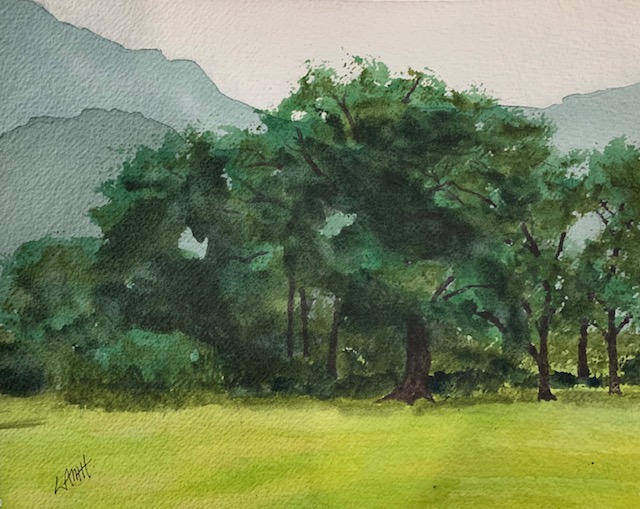
“Green and Overcast” Watercolor Painting.
GET TO KNOW YOUR BRAIN.
To understand how our usual mode of looking can cause problems when we paint, it’s important to understand more about how our brains work.
The human brain is constructed of two hemispheres, a left side and a right side. The two hemispheres of the brain, surprisingly, appear to have separate and somewhat different functions and capabilities. Research shows that both hemispheres are involved in high-level thinking, although each side is specialized for a different mode of thinking.
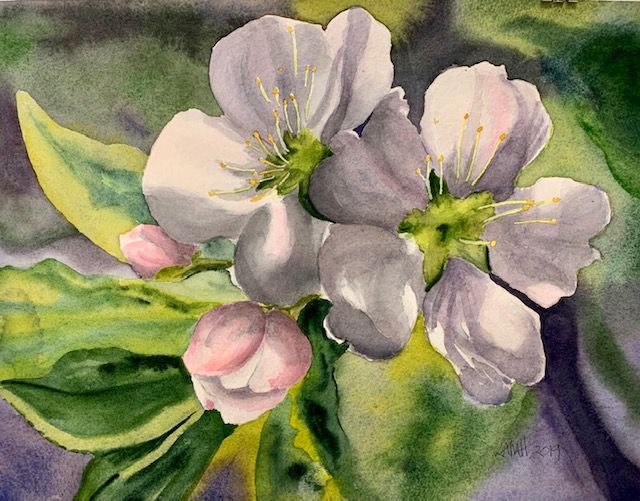
“Apple Blossoms” Watercolor Painting.
At times each hemisphere may share tasks with the other, with each half taking over whatever parts are suited to its style. However, what can often happen is one hemisphere will take over and INHIBIT the other.
Scientists have found that intellectual, analytic, verbal skills (like labelling) are performed mainly by the brain’s LEFT hemisphere. Our culture tends to value and celebrate left hemisphere thinking, so it’s no surprise that it can be our go-to mode. However, we can become overdependent on it, as the left brain may insist on taking over a project it thinks it can do “better” than the other half. The LEFT hemisphere, apparently, prefers NOT to give up tasks to the right hemisphere UNLESS it doesn’t like the job or finds it unimportant or boring.
In contrast, a second way of knowing (spatial, perceptual, nonverbal) is governed by the RIGHT hemisphere of the brain. Right hemisphere functions are required in art, painting, and drawing. Therefore, unless you can shift your thinking style to use right hemisphere skills, you tend to gloss over visual information, see what you expect to see, and fail to observe or paint accurately what is before you. (This is why your painted “tree” may look like a lollipop tree and not a real tree: your verbal, language-based, left hemisphere brain is hindering your art. Your left brain will actually CHANGE incoming visual information to fit its preconceptions without telling you. You will find that you CANNOT depend on what you THINK you’re seeing!)
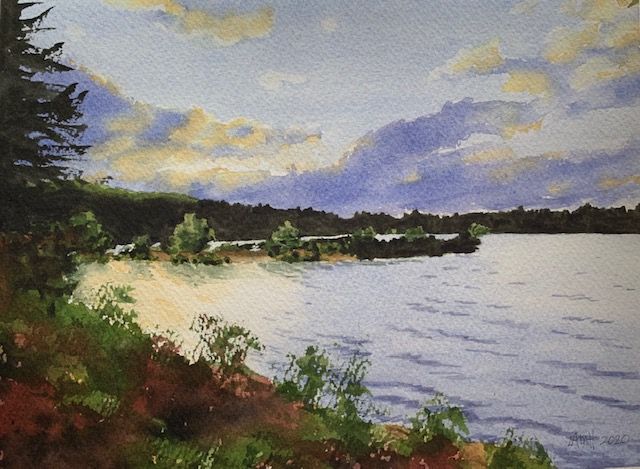
“Wachusett Reservoir” Watercolor Painting.
THE ARTIST BRAIN VS. THE INTELLECTUAL BRAIN.
Author Carl Purcell, in his book Painting With Your Artist’s Brain: Learn To Paint What You See – Not What You Think You See, emphasizes using the spatial, nonverbal side of the brain in painting. He believes the “generalities” of the intellectual, verbal, LEFT side of the brain “replace actual observation” and will “actually prevent you from seeing.” Purcell says “this interference from the intellectual brain will be the greatest problem you will face in developing your artistic skills.”
According to Purcell, to be a good artist, you need to train and rely on your visual, artist brain, i.e. the RIGHT side of your brain.The spatial and visual tasks performed by the RIGHT side of your brain generally do not require intellectualizing and may involve a “minimum of conscious thought.” This may be why, in part, chatting and talking (a verbal function of the left brain) during a painting class can interfere with good painting. Also, verbally finding fault with your own work (a left brain function) while in the midst of the painting process can also throw off your results, slow any momentum, and shift you from right side to left side functioning. In painting, the RIGHT side helps you see how shapes fit together, compares the values of different colors, and recognizes relative positions of objects.
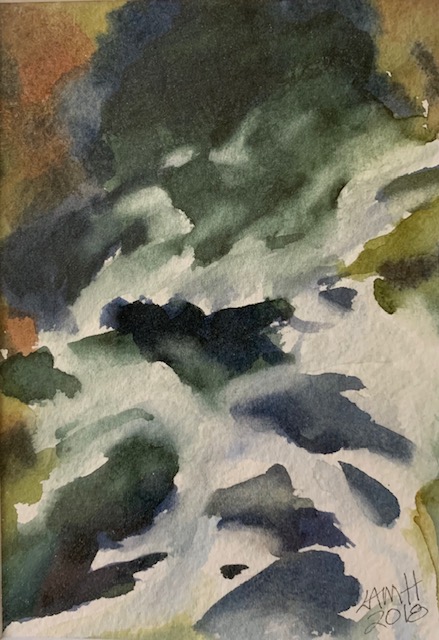
“Rushing Water” Watercolor Painting.
HOW TO SHIFT MODES AND LEARN TO SEE.
There are ways you can shift your thinking from a left hemisphere, verbal emphasis to a right hemisphere, visual mode that will improve your art. Your aim is to train yourself to bring the right side of your brain into CONSCIOUS use. In Drawing On The Right Side Of The Brain: A Course In Enhancing Creativity and Artistic Confidence, author Betty Edwards shows how to do just that. She teaches several practical techniques to help you shift your mode of thinking and learn to SEE. (Hers is an excellent book about perceiving, not merely a how-to-draw book as the title implies.)
Throughout Edwards’s book, you can learn the five simple perceptual (seeing) skills necessary for drawing and painting, including:
* Perceiving Edges (where one ends, another begins),
* Perceiving Spaces (what lies beside and beyond),
* Perceiving Relationships (perspective and proportion),
* Perceiving Light and Shadow (lights and darks),
* Perceiving the Gestalt (seeing the whole and its parts).
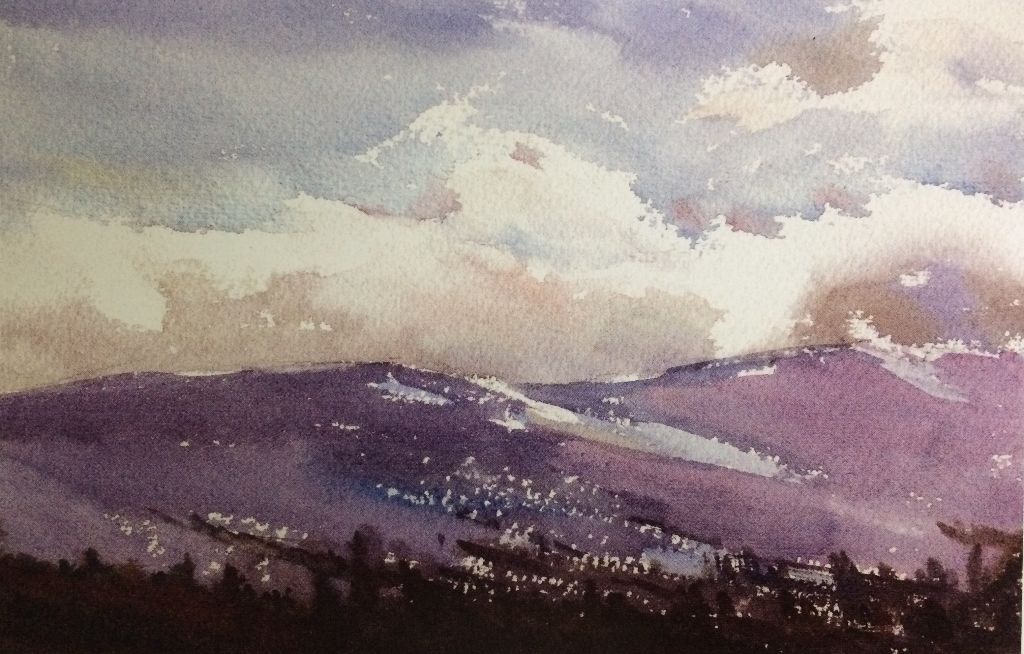
“Dynamic Skies Clouds Over Mountains” Watercolor Painting.
THE RESULT.
To improve your painting and ability to SEE like an artist while using the right side of your brain, stop attaching names to all the objects you see. Avoid saying, “It looks like a face” or “I want to paint that sailboat” or “I see an elephant in that cloud.” Instead, try thinking about and describing shapes. Look for basic shapes and notice how they are connected. For example, “I see a light shape against dark with some vertical lines.” or “There’s an orange shape between two bands of green.”
As you train yourself to observe shapes and spaces more accurately, you will SEE more like an artist and take note of important spatial details that contribute to good painting. Creative thinking and accessing your intuition become easier. Accurate perception and improved problem-solving also result. You may be surprised as you go about your daily life that you are paying more attention to your surroundings and seeing details that you never noticed before. You might start to look at the world around you differently. After all, that’s what artists do!
Join me and get painting tips, inspiration, recent art news, or information about new art or products for sale, sent to you occasionally by email. Subscribe here. I’ll give you a free copy of my Color Blending Tips pdf. that you can download and print.


Leave a Reply