 by
by What is it that makes a painting meaningful and gives it your voice and a personal touch? Most artists spend a lot of time and effort practicing technical skills and learning technique. They study and practice to improve their competence.
Nevertheless, a well-executed painting, even if technically perfect, can be lifeless and without feeling, especially if copied. What exactly do we mean by artistic voice? How can an artist paint with feeling, in their own way?
CHOOSE SUBJECT MATTER AND INTERPRET IT:
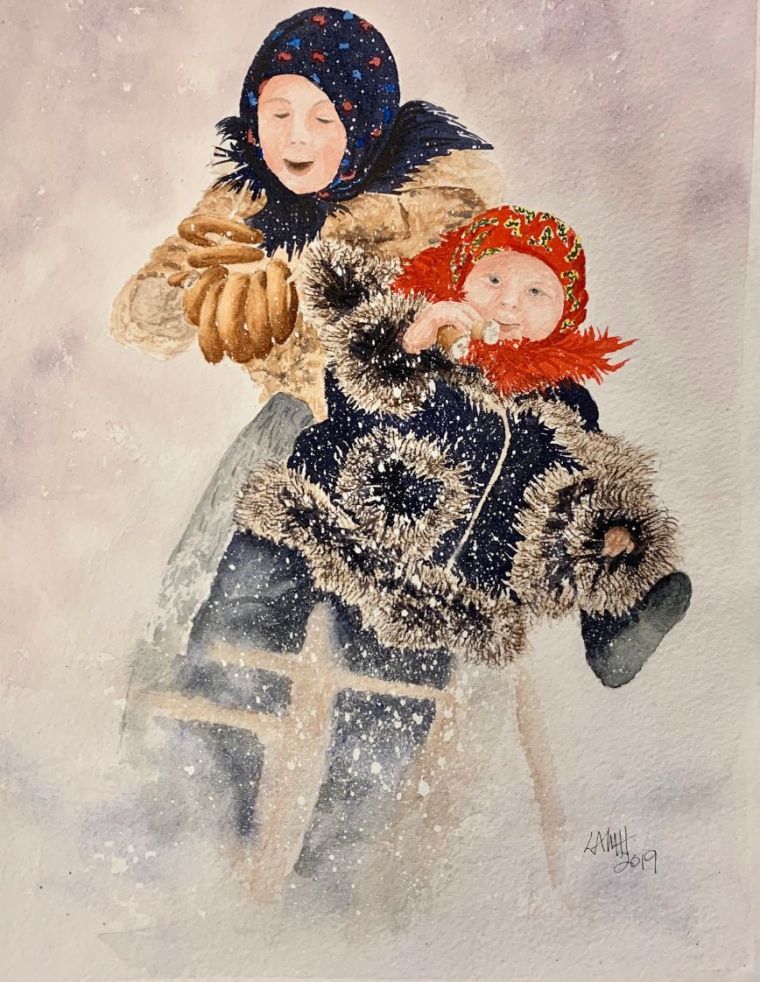
Voice is more than the SUBJECT MATTER an artist chooses to paint, although it begins there. Voice includes a personal INTERPRETATION of a subject. Each of us will see and describe a scene in a somewhat different way. When we paint, we hope to express our own POINT OF VIEW, our FEELINGS about the scene. By omitting or SIMPLIFYING details that seem unimportant and highlighting other details, you can focus on what is important to you. You might make an effort to limit your reliance on reference material, at least to some extent, to allow for more interpretation. Decide what touches you about a scene, rather than blindly copying (without thinking) all the details of what is before you. Work from your own photos. You might sketch and paint from the sketch. Do this, and you will begin to develop your ‘voice.’ Tell your own story!

GET TO KNOW YOUR OWN FEELINGS AND LET THEM SHOW:
It is not easy to create art that expresses your feelings and personality. You may need to get to know yourself better and begin to identify what truly interests and excites YOU. Instead of copying other artists by painting what they paint in the same way they paint it, don’t be afraid to do it your way. What makes you an individual is what will develop your painting voice. It’s your feeling about a work that helps the viewer to connect, on an emotional level, to your picture. Strive to show an imaginative, original, unusual, perhaps even surprising, viewpoint. Experiment!

PAINT BOLDLY:
TIMIDITY and FEAR OF MAKING MISTAKES are two obstacles to establishing your painting voice. When you paint with hesitation and uncertainty, you tend to create tight, stiff, overworked images. Strive to loosen your BRUSH STROKES, painting more BOLDLY and with LARGER brushes. Small brushes make it too easy to paint minute details, leaving nothing to the imagination of the viewer. Instead, reduce and omit nonessential details, thus allowing a viewer to become involved in imagining and filling in ambiguous specifics for themselves. One technique to increase viewer connection is the use of LOST AND FOUND EDGES in painting. (For example, vary your edges by using hard edges as well as soft or disappearing edges to create interest in your picture.)

USE COLOR IN YOUR OWN WAY:
COLOR CHOICES can play an important part in developing your voice. The paint pigments on your palette affect the feel and flavor of your paintings. The Zorn palette, for instance, created and used often by Anders Zorn, is one factor that makes his paintings recognizable as his. His palette often consisted of primarily four colors: yellow ochre, ivory black, vermillion, and titanium white. Vincent Van Gogh, on the other hand, tended to prefer other color combinations, as did Johannes Vermeer and Claude Monet.

CAREFULLY OBSERVE AND EMPHASIZE SUBTLETIES:
Beyond the colors on your palette, artistic voice also depends on how you ’SEE’ what you choose to paint AND how you might choose to EXAGGERATE subtler colors. (For more information on ‘seeing’, check out my blog post entitled “Painting Begins With Looking and Seeing,” https://leemuirhaman.com/2018/12/18/painting-begins-with-looking-and-seeing/, published December 18, 2018.). Your ‘voice’ thus involves looking carefully and analytically at a subject, and taking the time to observe and contemplate. Decide what you really want. Without careful looking and consideration, your paint colors can tend to be flat, conventional, tired, and uninteresting. We have all seen beginners who paint trees or grass an unvaried, unnatural green. Strive instead to observe subtle color variations which are almost always there to be seen. Further, use your imagination to emphasize or exaggerate some of the subtler, more elusive colors to suggest to your viewer WHAT YOU FEEL about your subject.
CAPTURE THE LIGHT:
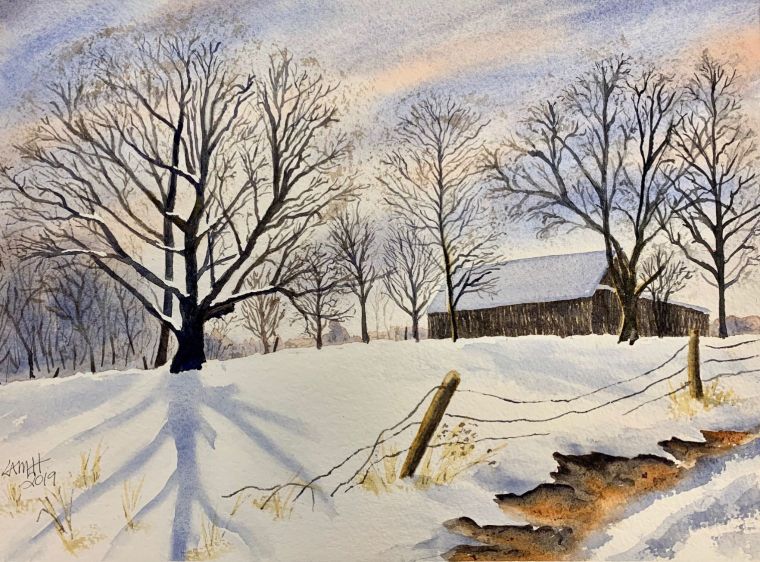
Observing and capturing the QUALITY OF LIGHT in an everyday scene will help you to develop your voice and feeling. Again, study your subject and really look for the nuances and subtle variations of light at different times of day and in different locations. Light affects how everything appears, whether it be the strong golden light of summer or the soft purple-gray mist of a rainy day. Shadows, whether cast or reflected, also tend to have rich and subtle color variations that you will want to interpret for the viewer of your art.
IN SUMMARY:
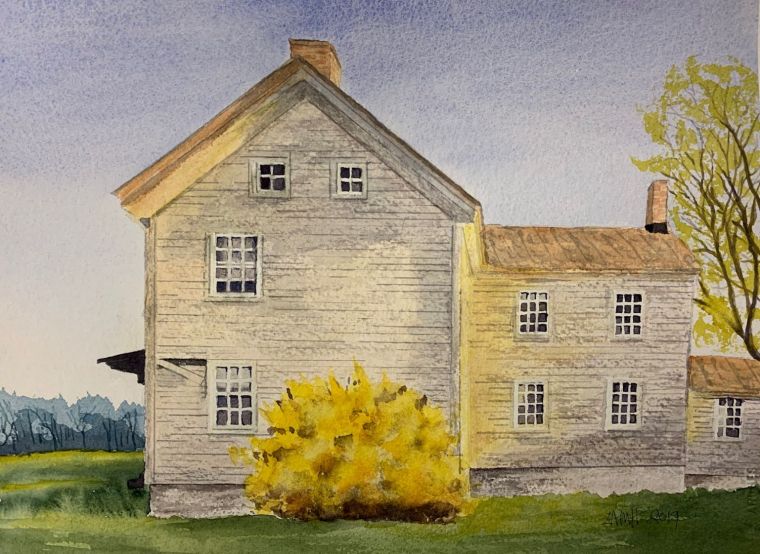
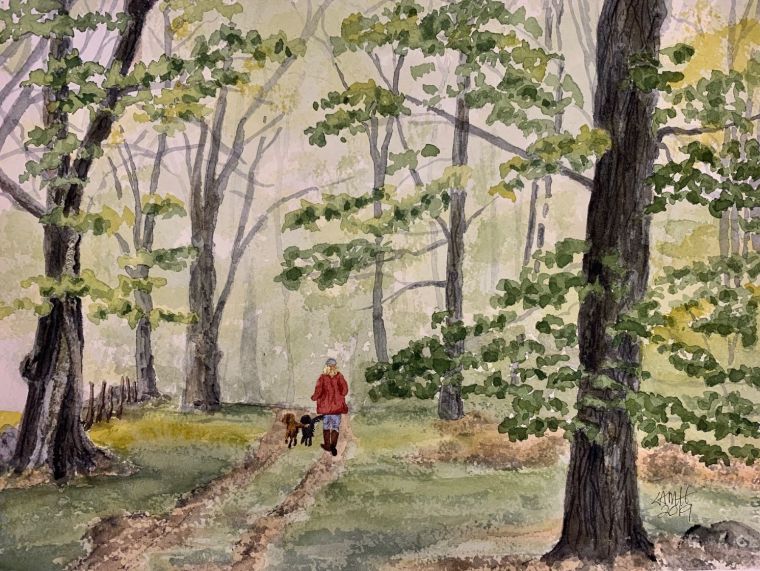
One artist will interpret a scene differently from another. In choosing the essentials and leaving out unimportant details, a painter begins to develop their personal voice. Further, your selection of colors, materials, and techniques to use in painting will be unique, unlike another’s. Over time, each of us develops our own characteristic and distinctive shorthand for dealing with familiar objects; these habits can become recognizable. For instance, I often paint trees by scumbling the leaves, and I use lots of dry brush when painting rocks and stone walls. An artist’s selections, simplifications, and techniques are individual, making voice a natural evolution within an artist’s work. However, to develop voice fully, you must move on from simply considering materials and techniques to delving deeper and getting to know yourself and what you value. What do you like? What do you care about? What do you want to say? Be sure to express your feelings about a picture; be creative. Remember, your voice is yours alone!
To delve even deeper into the subject of creativity, check out my blog posts entitled “Fostering Creativity” (9/24/2019), https://leemuirhaman.com/2019/09/24/fostering-creativity/, and “Creativity Can Be Learned!” (1/8/2019), https://leemuirhaman.com/2019/01/08/creativity-can-be-learned/.
Join me and get painting tips, inspiration, recent art news, or information about new art or products for sale, sent to you by email. Subscribe here. I’ll give you a free copy of my Color Blending Tips pdf. that you can download and print.
 Lee Muir-Haman Watercolor Painting
This is exactly what I needed to read today. I’ve been painting with watercolor for just a year now and I find myself struggling to develop my “style”. So much to absorb in your post. Thank you!
LikeLike
Thanks for your wonderful comment! I’m thrilled to hear that my post was interesting to you.
I hope it helped you to understand the various things that make up a personal painting style, but also
to realize that a ‘style’ develops on its own at its own pace. Try to not worry about developing your style –
if you paint what interests you and have fun doing it, you’re golden!
Keep painting! Lee
LikeLike
I love your painting style. Thank you for sharing your painting advice. As a beginner, I really appreciate it.
LikeLike
Thank you for the compliment! I’m thrilled you are enjoying the blog and finding
it helpful.
Keep painting, no matter what – hope it’s fun! Lee
LikeLike