 by
by This post is a continuation of my thoughts on art and creativity, begun in
The Slim Black Notebook (11/25/2025), https://leemuirhaman.com/2025/11/25/the-slim-black-notebook/ .)
I’m thinking of it as a slim black notebook to corral and contain some distilled art knowledge that I want to remember as I go along, almost like a journal to myself. It may contain insights and philosophies about creativity (gathered from other creatives and my own thinking), methods of working, themes important to me, and perhaps techniques and thoughts on color, whatever seems pertinent and helpful to what I am curious about and learning. It won’t necessarily even be constructed all in complete sentences. And it will be an incomplete, ongoing project (undoubtedly with other segments and revisions at a later date). These are not rules. Take what you like and use what you find useful.
PERFECTIONISM AND FEAR.
Perfectionism at its core is not about high standards, but about Fear. It’s about fear of failure, fear of looking stupid, fear of making a mistake, fear of being judged, criticized, and ridiculed. It’s a fear that “You’re not good enough.” might actually be true. (Marie Forleo)
Perfectionism is self-abuse of the highest order. (Anne Wilson Schaef)
To avoid perfectionism, never make anything perfect. Trying to be perfect is exhausting. And the only way to be perfect is to do nothing. Find things you can be good at instead, your strengths. (Megan Auman)
Perfectionism is paralyzing. It is destructive. Fear saps passion. It keeps you suffering. Perfectionism loves drama.
The fear never totally disappears. Don’t believe that the fear must be overcome before you can do your work, your art. To avoid being paralyzed, don’t focus on the fear. Recognize the fear, stop talking about it, and get into ACTION and the fear will begin to recede. Start. Fear is no excuse to let yourself fail. Don’t overthink, act.
When we believe that success should be effortless, we simultaneously set ourselves up for shame AND diminish the efforts of those who are doing work on their own issues of perfectionism. We need to reality-check our expectations. (Brene Brown)
Fear is the one thing that keeps many artists from realizing their best dreams, even more so than a perceived deficit of talent or opportunity.
Bravery is often the only thing that stands between starting and accomplishment. Getting past fear requires determination. If your idea and desire are important enough to you, you will find a way. (Mary Whyte, artist) “Whatever you can do, or dream you can, begin it. Boldness has genius, magic, and power in it. Begin it now.” (Goethe)
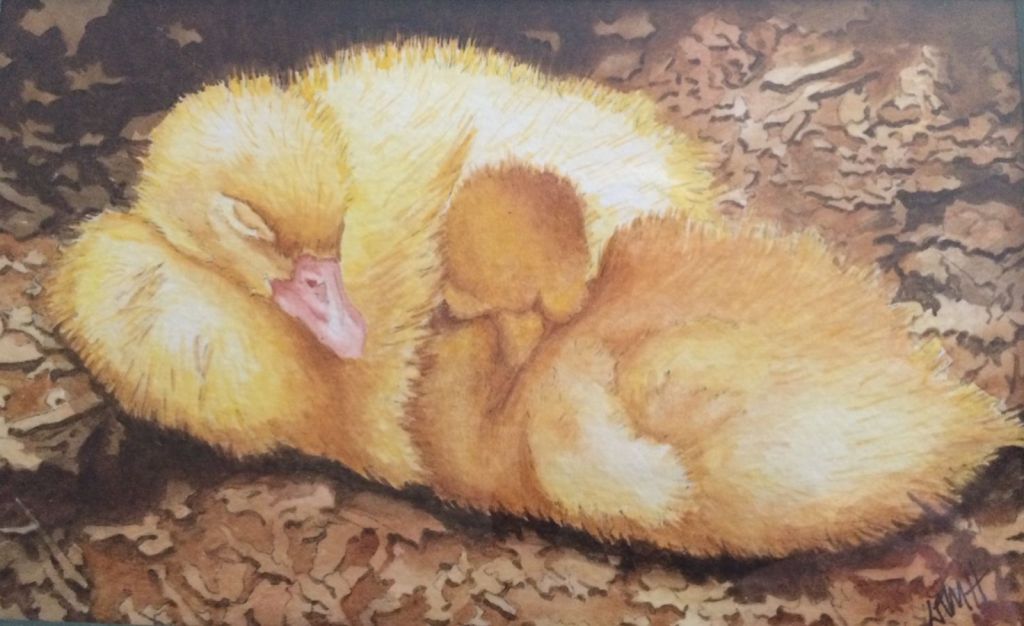
“Ducklings” Watercolor Painting.
FEAR OF SUCCESS.
Our deepest fear is not that we are inadequate. Our deepest fear is that we are powerful beyond measure. It is our light, not our darkness, that most frightens us. We ask ourselves, Who am I to be brilliant, gorgeous, talented, fabulous? Actually, who are you not to be? You are a child of God. Your playing small does not serve the world. There is nothing enlightened about shrinking so that other people won’t feel insecure around you. We are all meant to shine, as children do. We were born to manifest the glory of God that is within us. It’s not just in some of us; it’s in everyone. And as we let our own light shine, we unconsciously give other people permission to do the same. As we are liberated from our own fear, our presence automatically liberates others. (Marianne Williamson)
Change the voice in your head saying “Who am I to think I can do this?” or your progress will be forever hampered. Be an experimenter. You must ignore naysayers. Step away from the pack and the predictable. Grow into your best work, with time and persistence. Every mistake is an opportunity for something new and better. (Mary Whyte, artist)
YET ANOTHER CLASS?
You don’t need another tutorial, more instruction, learning, or research before you start to paint. (Julia Bausenhardt) Stop consuming and comparing. Avoid binge-watching and scrolling. Passively watching content is decidedly easier and safer than creating art yourself, but does not improve your skill or feel fulfilling. If you believe you must know everything before you start, you can easily perpetuate avoidance and prolong over-thinking. Instead, start. Commit to begin before you feel ready. Allow yourself to be a beginner and make mistakes. Your work may not be perfect, but take small steps and keep practicing to get better. You will learn by doing, and make more progress than by consuming more information or thinking without taking action.
This very moment, we can change our lives. This second, we can sit down and do our work. (Steven Pressfield, The War of Art)
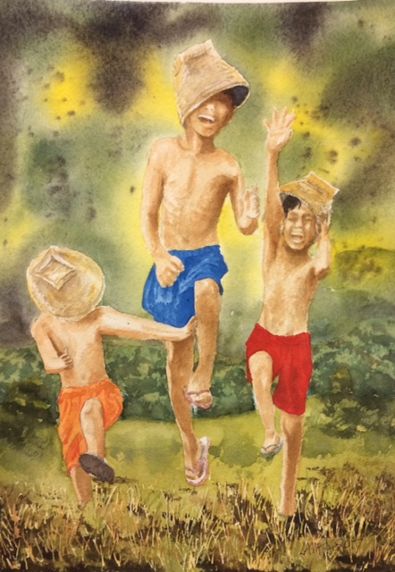
“Laughing Boys” Watercolor Painting.
PAINTING LOOSER.
To help avoid tight, overworked paintings:
- Avoid being sloppy and reckless, but strive for relaxed and intuitive brushstrokes. Try to get focused and in “the zone”, where you’re not actively thinking about or judging what you’re doing but are in flow (Dan Scott, artist) Paint with quick and lively, confident brush strokes. Don’t squeeze your brain tight trying to concentrate, but rather relax it and bypass the inner critic (the “editor”). Focus on the process of painting rather than worrying about results – Never mind what you end up with!
- Use larger brushes to avoid getting caught up in tiny details.
- Paint hard, soft, AND lost edges, i.e. varied edges, to help the viewer get interested and involved while looking at your image, and to steer them toward your center of interest.
- Have your watercolors in the palette moistened and ready. Make sure you have enough of each on your palette so the process of painting won’t need to be interrupted once you start to paint.
- Simplify by emphasizing the most important aspects of the subject and placing less focus on the rest. Try painting from a black and white sketch (or a photocopy) to help you simplify, to avoid too many details and overwork, to capture values, to make the picture your own.
- Painting outdoors can force you to loosen up your painting. The changing environment gives a sense of urgency to a painting. You won’t have time to be too fussy over details before the light or weather changes. You must work quickly to capture the essence of your image. (You can mimic this helpful limitation in the studio by setting yourself a time limit, perhaps 20-30 minutes for a project.)
- Try to warm up before painting. Play with marks and colors in your sketchbook or on scrap paper. Continue to play around until your mood is easy and relaxed. You’ll be less tense and worried when you shift your attention to actually painting your image.
- Finally, know when to stop! Avoid trying to correct every little mistake. Don’t overwork your painting. Instead, stop painting just BEFORE you feel you might be finished. ( Loose Or Overworked?, (6/20/2023), https://leemuirhaman.com/2023/06/20/loose-or-overworked/ .)
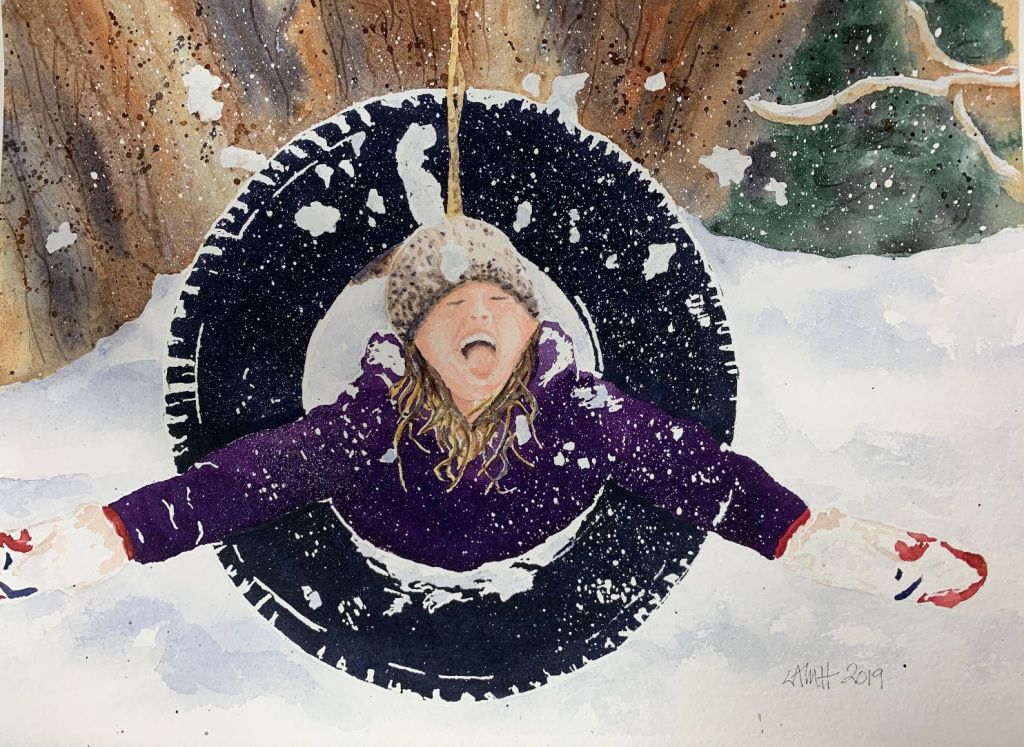
“The Tire Swing” Watercolor Painting.
INSPIRATION.
Generating your own writing (painting) subjects is a true sign that you are becoming your own writer (painter). (Natalie Goldberg, writer)
Subject matter is neither pretty or ugly, as the beauty of a painting lies in the work itself. Everything is worthy of being painted, even an everyday object, such as muddy boots, or a dull, gray day with lots of muted color. What is important is how we respond to what is before us, and in order to do this we need to identify what makes our heart sing. Good painting is the result of close observation AND your thoughtful response. It is a point of view, as well as a feeling, in that one moment. It is about seeing, not just with the eyes and the intellect, but with the heart and soul as well.
When painting, take the opportunity to alter or enhance your perspective, emphasize your feelings, show the energy and essence of the scene, and make the painting something engaging. Show what your heart is responding to.
Instead of demonstrating your talent, technical ability, and how you finished the painting, show what it was that made you want to begin. Show what only you have seen, the thing we have never seen before.
Our earlier sketches and paintings are echoed by later ones. A thread connects them, one dream to the next. We seem compelled to come back to familiar ground. What spoke to us from the very beginning is what speaks to us still. This is who we are, the foundation upon which a lifetime of ideas and passions are built.
Art transports us back to our deepest familiar, while at the same time brings us closer to our most raw, honest, and yet-to-be discovered self.
Originality is born from knowing what is essential to you – in other words, knowing what specifically moves you and gives you joy.
Our true aim as artists should be to nurture the sensitive quality and appreciative imagination that we once had as children. As we grow up, society suppresses much of creativity as fanciful or wasteful. We spend most of our time attempting to act like mature adults, and then wonder why our lives seem empty. Where did all the fun go? (Mary Whyte, artist)
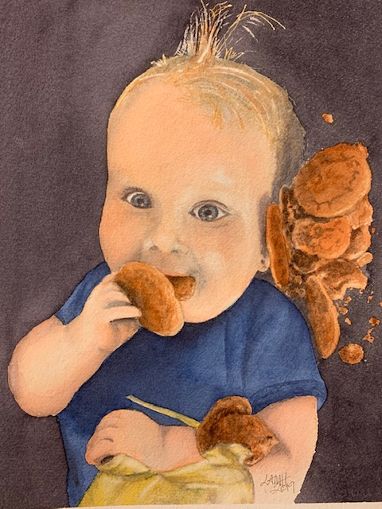
“Wren’s Cookies” Watercolor Painting.
TEMPERATURE OF SHADOWS.
A warm light will produce cool shadows, and a cool light will produce warm shadows.
YOUR TRUE VISION.
Try this exercise: Make column headings of the five senses: sight, sound touch, taste, and smell. Write ten to twenty things under each of the five categories, things that quite literally take your breath away.
Take your time. List only unique and highly personal answers that reveal where your most meaningful and truthful expression lies waiting. List what excites you, lifts your spirits, not typical, obvious, or generic responses. If you give this task thoughtful consideration, the list will point you towards what you truly want to paint. (Mary Whyte, artist)
TO SUMMARIZE … SO FAR.
This is a good place to stop writing, for now. I have included some distilled art knowledge that I find interesting and want to remember as I go along in my painting, information that has meaning for me. Again, these are not rules. Take what you like and use what you find useful. Until next time…
Join me and get painting tips, inspiration, recent art news, or information about new art or products for sale, sent to you occasionally by email. Subscribe here. I’ll give you a free copy of my Color Blending Tips pdf. that you can download and print.


Leave a Reply